Monday, July 25, 2016

Mama Mia! Stirs the Seismographs

The bicycles back in the truck box, we went to Amherst Shore to take advantage of the kind nature, generous hospitality and boon companionship offered by good friends Carole and Garth. For some long time I have been keen to show them off to my dear old Mum – and her to them – so we went off to Truro to realize the dream. No one was disappointed. Each charmed the other. I was lauded for my taste in friends – and my good fortune at having landed Doris as my mother.
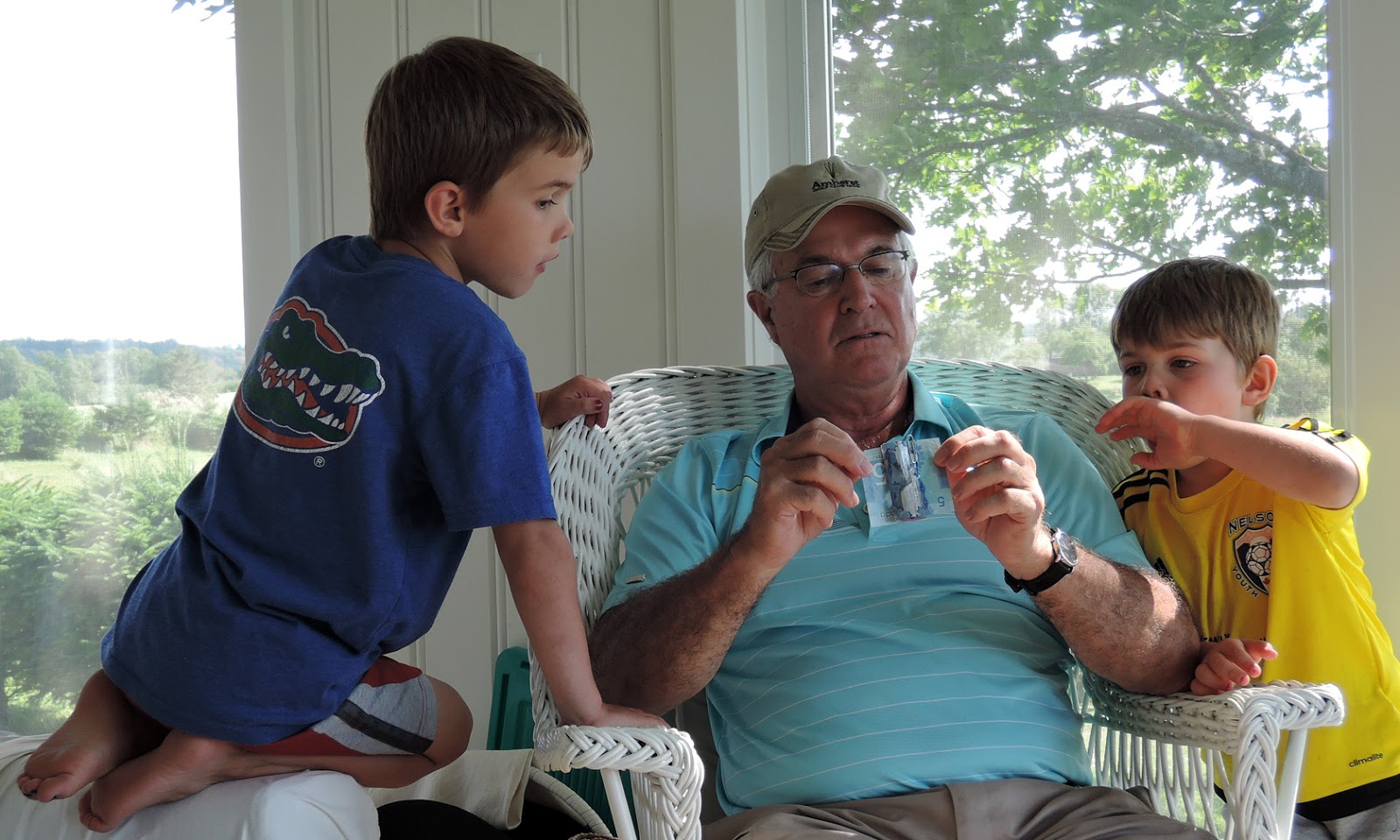
We moved on to Black Rock to greet the elder Nelsons and fly kites with Teo and Luca, aged 7 and 4 respectively. Gifted with some considerable talent as an amateur prestidigitator – magician if you prefer – Garth put on a show for the boys. Using only rubber bands, paper clips and a five-dollar bill he delivered effects just about as jaw-dropping as delivering a rabbit out of a hat. Garth was not the first nor will he be the last to fall victim to the charisma of young Luca. He offered to take Luca home – a supplement to the nine grandchildren he already has. Not surprisingly, the offer was declined.

The waters of the Northumberland Strait are the warmest north of the Carolinas but our agenda was too crowded to accommodate languorous time on the beach. We took the Confederation Bridge to Prince Edward Island, savoured a walkabout and ice cream at Victoria-by-the-Sea, stopped at old church cemeteries to see what historical prizes we might find.

Some of the country’s finest soldiers-in-bronze grace the war memorials of PEI. I was enthusiastically listing the virtues of George W. Hill’s three stalwart infantrymen on the Charlottetown cenotaph when a lovely little lady asked if she might eavesdrop. I said sure. It turned out that she is a native south Italian – ‘That’s why I’m short’ – who was intrigued to learn that I’m about to have a book published on the subject of war memorials. She wanted the details, intending to buy copies for her sons. Which suited the author perfectly well.

That evening we were just four of the great throng of theatre-goers having the time of their lives reveling in Mama Mia! at Confederation Centre. Everyone else seemed to know what I didn’t: that the show uses the songs of Abba to tell a happy story about love and connection, loss and reconciliation. By the end of the show, all of the people in the house were on their feet, singing their lungs out, grooving in the aisles. The building rocked, the seismographs at far-off Bedford in Nova Scotia recording the tremors. 

The next day it was off to the Island’s second city, initially to dine on a huge dollop of fish-and-chips at Sharkey’s on the Summerside waterfront, then to admire another bronze, the brilliant Emanuel Hahn evocation of an infantryman going into action that the lucky folks of Summerside get to admire any time they want.

En route to Malpeque on the Island’s north shore someone spotted a roadside sign pointing the way to a purveyor of iron products, at Annan. The items on display, a fanciful montage of weird birds and animals, are all transmogrified from cast-off bits of metal – old shovels, spent tools, bicycle frames, rebar, nuts, washers, you-name-it. Garth walked away with a bright red lobster, Jan with a multi-coloured creature inspired by a cartoon character, whether Heckle or Jekyll I cannot say.

At Malpeque there was another bronze soldier to admire, this one by Hamilton MacCarthy, and more seafood to savour at the Oyster Barn, next door to the lobster fleet tied up at the Malpeque wharf. As if all this were not reward enough there was one more gift to relish. 

At Indian River there is a marvelous old wooden church, St. Mary’s, that is now the venue for the Indian River Festival.
The evening’s attraction at St. Mary’s was The Door You Came In, a musical story delivered by David Macfarlane and Douglas Cameron based on The Danger Tree, Macfarlane’s brilliant memoir of family and war. The Door You Came In is excellent: evocative, moving, resonant. 

For years, whenever urged to write a book of my own, I have been wont to duck, saying the book I would want to write has already been written: The Danger Tree. Eventually I changed my mind and wrote a book about – what else? – war memorials. It is to be published by Heritage House in November, just before Remembrance Day. Now, someone has written a foreword for the book, a well-considered and generous one. That someone is David Macfarlane. 

It has been a good week.

Slight Chance of Showers

Take it with a grain of salt when the weatherman promises sunny weather with only a slight chance of showers. We went to the Nova Scotia mainland to try out two or three of the recommended bicycle routes in a 1993 book, Biking to Blissville, by Kent Thompson. We launched the adventure with the 50 km Wolfville-Kentville route Mr. Thompson recommended. Starting at the old Wolfville train station, we had barely pedaled 30 feet before rain commenced. In a very short while the deluge grew torrential and we were soon soaked to the skin. 

I have never considered rain and riding to be a match made in heaven. I have been known to howl loudly when rain annihilates whatever fun might have been had in its absence. Fortunately on this particular day precipitation proved to have a silver lining: the day was hot and I soon discovered that in a swelter rain provides welcome, natural air conditioning. I changed my mind, took off my shirt, enjoyed the cool.

On the way to Centreville Jan and I were joined by frequent loud thunderclaps. I tried to recall how many people caught out in open country are killed each year by lightning strikes. In the village we spotted Foote’s ice cream parlour and stopped for shelter and a calorie upload. I was barely into the first scoop of my triple-decker when all hell broke loose: a torrent the like of which I’d experienced only once before, years ago during a flash flood in Tucson, Arizona. Slight chance of showers indeed.

Soon enough the rain stopped as suddenly as it had started.Back on the bikes, sun emerged from behind the clouds and the sweltering heat returned too. I almost yearned for a cooling shower.  The back roads of Kings County provide abundant charms for a slow-pedaling cyclist from away: sparse motorized traffic, birdsong, grand old houses, verdant countryside, and occasional serendipity. We chanced upon diminutive Gibson Woods United Baptist Church and learned from an interpretive panel that the community had been settled by black families descended from slaves, free Black Loyalists and War-of -1812 black refugees. I’d had no idea.

That was just one of the history lessons. Always on the lookout for war memorials, at Canning we admired the 1902 Hamilton MacCarthy bronze bust of Lt. Harold Lothrop Borden, killed in action at Witpoort two years earlier, during the South African War. At the Canard cemetery Jan spotted a white bronze grave marker looking every bit as crisp and clear as the day it was installed in 1888. `White bronze` is actually zinc; markers made of it endure wonderfully well, having no natural enemies and only one human one – vandals.

Having already inspected Henri Hebert’s fine, evocative bronze of ‘Evangeline’ at the Grand Pre national historic site, where the shameful 1755 deportation of French Acadians is commemorated, we found another facet of the same story: at Starr Point a cairn records the arrival in 1760 of the first ‘New England Planters’ brought in to replace the expelled Acadians. A tablet on the cairn notes that the surroundings include some of the most fruitful agricultural lands in all of Canada. The Acadians had known all about that.

The next day we rode 40 km in Annapolis County. Granville Ferry availed a further array of fine, gingerbread-festooned old houses, and Mills Cemetery, devoted to a single family, some of the gravestones nearly two centuries old. We stopped at L’Etablissement Melanson – Melanson Settlement – another community of Acadians expelled after close to a century of peaceable and productive life on the banks of the Dauphin River (renamed Annapolis by the British evictors).

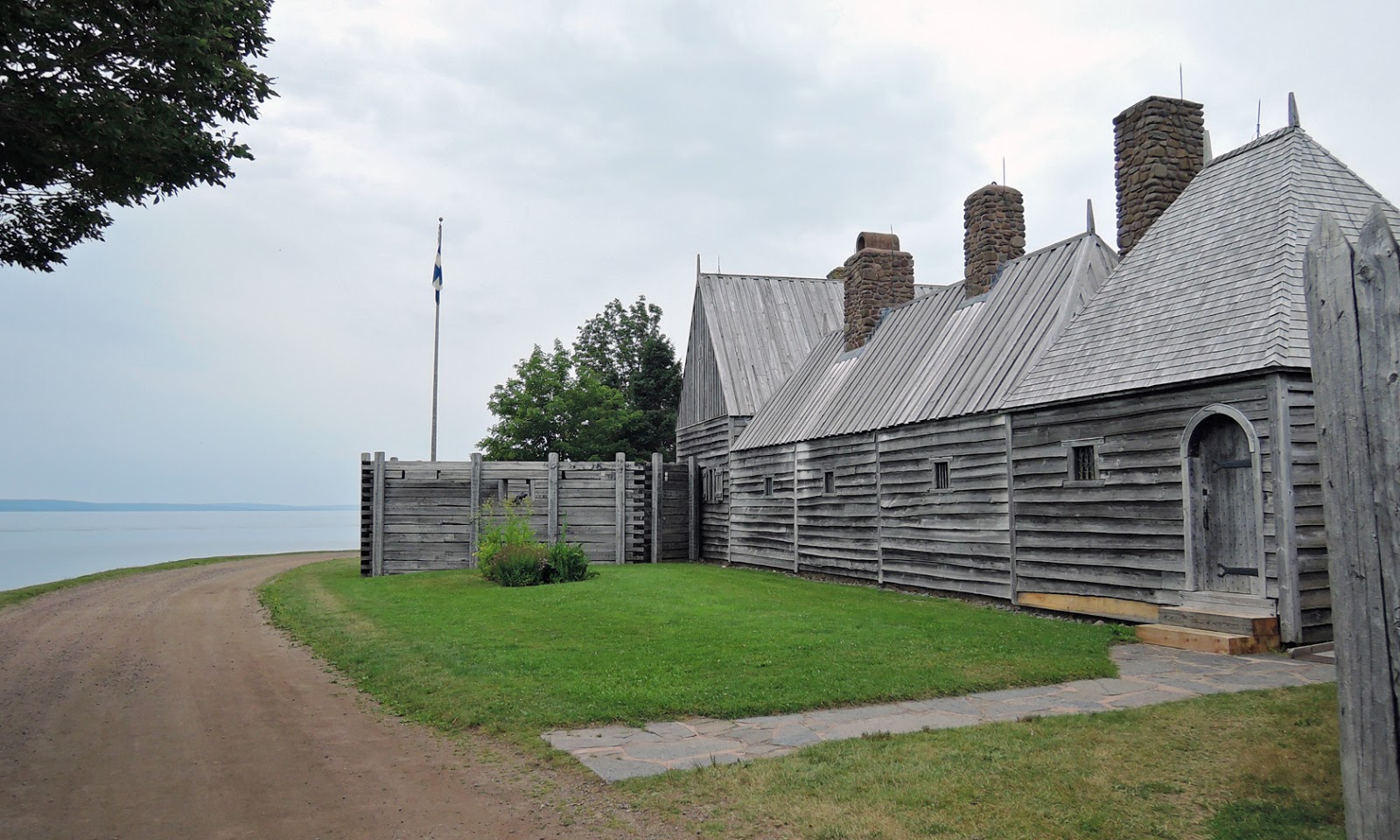
At Port Royal the history is older still. We stopped to contemplate the replica of the 1605 habitation established by Champlain and friends more than four centuries ago. 

We climbed North Mountain on the bikes and rode the shore road along the Bay of Fundy. One of the rewards of riding a bike 40 or 50 kilometres is the entitlement one feels to make a pig of oneself. We dismounted at the Crow’s Nest at Parker’s Cove, reveled in fresh seafood then paused at the community’s tiny harbour where the lobster boats sit on the harbour bottom until the world’s highest tides return to lift them up again.

The showers may not have been as light as Environment Canada mooted but we didn’t grumble: the history lessons edified and the ride boosted our confidence that even as old age encroaches we retain a modicum of fitness and viability. Yahoo!

Thursday, June 30, 2016

Early Days at Big Bras d'Or

Conventional wisdom holds that nature abhors a vacuum. We arrived in Cape Breton the first day of summer and quickly noticed some of the consequences of having missed last year’s season at ‘Bigador’. The premises are never exclusively ours. Inside the cabin we found abundant markers that deer mice had enjoyed the run of the place these past twenty months. Steady vigilance must be applied against opportunistic squirrels: turn your back for half an hour and one is likely to chew its way through a screen to see what delectables might be found inside.

In the corner of the sun room what at first appeared to be an out-of-season snowdrift turned out to be wood dust: the pile of tailings left by the colony of carpenter ants that have been busily excavating the cluster of two-by-fours we rely upon to support roof and walls. In early days a warm evening produced a wonder of nature: rather like Old Faithful at Yellowstone, a geyser of winged ants poured out of the corner, hundreds of them, their mission to establish outpost colonies elsewhere. Pandemonium ensued as we sought to impose our will on their intentions.

The space between the cabin and the shore was open when we left in October two years ago.  Now it was chest high with the maple, birch, rose and mountain-ash that flourish like hacked-up starfish when no one is available to keep them under control. 

Like the fellow who built it 45 years ago, the cabin is ‘getting on’. Faded and peeling paint is twice as evident when you’ve been away for two years rather than the customary one. Here there is rust, there a bit of rot. There will be no basis to claim a shortage of things to keep us occupied as summer proceeds.

Thus the first week in our little private shangri-la afforded projects generously. Bleach and Lestoil helped deal with the proceeds of the mouse inhabitation. Live-and-let-live is policy I generally endorse but, take my word for it, carpenter ants cannot be allowed to follow their bliss in a cherished building. Ant-B-Gone may deal a fatal blow to the colony; if not, something else must.

I fired up the Stihl brush cutter and went on full frontal attack against the burgeoning maple and poplar. I took wire brush and scraper to peeling paint, retrieved brushes and rollers and applied fresh stain to the deck and outside bench. The old place looks considerably brighter already.

Fortunately there is more to cabin life than toil. We start most days with a six-kilometer walk from the cabin to and around Dalem Lake. Black-throated green warblers, ovenbirds and hermit thrushes offer morning vespers as we wend our way. Back from the lake, neighbours – Derrick and Donna, Jim and Cindy – put on the kettle for tea and brief us on what’s been going on in the months our backs were turned.

Serendipity flows: the Squires brothers, both Kevin and Stuart, delivered welcome-back tribute: lobsters fresh out of the salt water. We went over Kelly’s Mountain for the 2016 edition of the Englishtown mussel fest, met up with old friends and had our year-first taste of Cape Breton fiddle music. 

Among the reliable features of summer at the cabin are the ultra-competitive bananagrams games we play with the monozygotes, identical-twin cousins Lynn and Louise. We play a version allocating 36 tiles to each player; our rules prohibit two-letter words and oblige competitors to play one word comprising eleven letters. It ain’t easy. Lynn ordinarily trounces everyone in sight and gets the job done in less than ninety seconds. In a bananagrams world she is Einstein. Before the first bout Jan and I speculated whether Lynn would surpass the combined score of her three adversaries. Something historic happened: she didn’t. It was Louise who outscored the rest of us, 11-9. Why shouldn’t the second twin prove as lethal as the first.

And so it goes: the early days of summer dependably deliver anticipated attractions. We sit in the porch like Fred and Martha feasting on the view over the Great Bras d’Or and Kelly’s Mountain. Bald eagles – sometimes several at a time – course the shoreline. Lobster boats pause at their painted floats to collect the day’s bounty. A white-throated sparrow belts out his own special arrangement of Oh Canada, Canada, Canada. The song of the wild is a loon yodeling his northern melody from the water in front of us. Can there be a better backdrop on the eve of our country’s 149th birthday party?