Having sat idle for two whole years we decided it was high time we put the camper on the road again. Nature abhors a vacuum, the saying goes. So it seems: an array of wild things had taken up residence in various corners – sow bugs, spiders, ants, even a cricket or three. Ignoring the doctrine of squatters’ rights, we gave them all the heave-ho, washed off the grime and discovered that apart from a balky jack, all of the camper’s mechanical bits seemed to work just fine. We decided to go to Prince Edward Island.
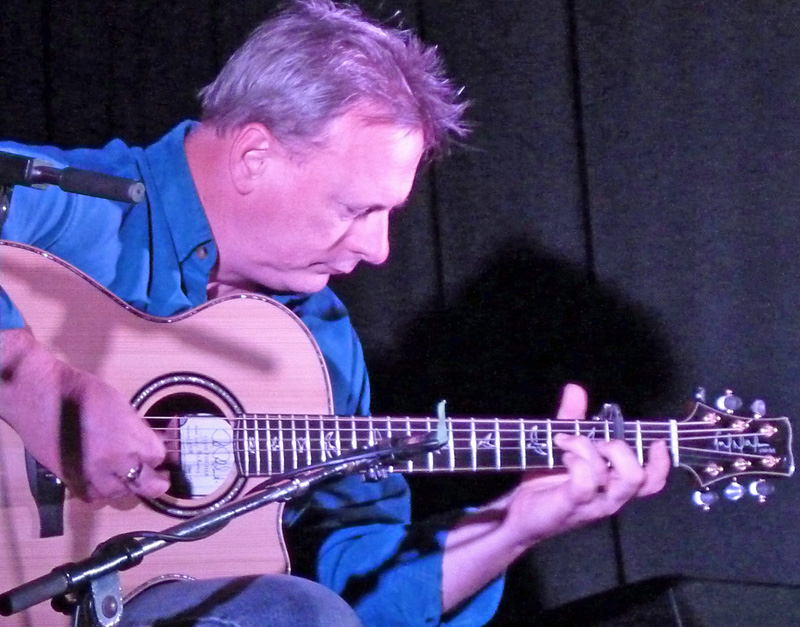
Serendipity made a return performance. En route to the Island we learned that a music event, the Festival of Small Halls, was underway – 42 events over 11 days in 34 small halls – and that a particularly fetching one was set for North Rustico that very evening. We arrived at the Caribou ferry dock just in time to roll on to the 2:45 sailing, the last vehicle through the gate. More serendipity: at the PEI visitor at Wood Island we found that there were two tickets left for ‘Night Out in the Crick’. The sellout crowd ate up the event, literally. As if the musical offerings – from Tony McManus, Catherine MacLellan, Troy MacGillivray, et al – weren’t enough (and they were), the organizers provided free food too, headlined by help-yourself Island mussels. Night Out in the Crick was so swell we ate up two more gigs, ‘Belfast Hosts the Grammys’, Gordie Sampson, Liz Carroll at the Belfast Presbyterian church, and ‘Girls Night Out’ (Liz Carroll again, Andrea Beaton, Meaghan Blanchard and pals) at Munns Road near PEI’s eastern tip.
Without really meaning to we went to the Garden of the Gulf at just the right time. There was plenty of room at the one national and several provincial park campgrounds we frequented. Come a week later, we were told – after Will & Kate have taken their turn – we would find the same facilities booked solid.
Even by comparison to its Maritime neighbours PEI is an oddball. The island is settled throughout, much of it apparently by potato farmers. There is hardly any litter at roadside. Do they shoot people who dare to throw a Tim Horton’s cup out the window? The ‘Garden of the Gulf’ moniker suits: there is no wilderness on the Island, the moose, bear and deer are all gone. Happily there are still wildflowers and birds. Never having been in the western end of the Island we rumbled to North Cape, where an array of big generators contributes significantly to the Island’s power grid – 18 per cent of PEI’s electricity is wind-generated. Who knew? At North Cape we walked the Black Marsh Trail, saw a fine array of bog-barren wildflowers and soon discovered that, fierce as the North Cape winds are, they weren’t up to the task of keeping Cape mosquitoes at bay.
We walked the storied red sand beach at Cavendish national park. At Red Point it is the sandstone cliffs that are red, the beach is of the ‘singing-sand’ variety, and almost white. After North Cape we drove the whole length of the Island (it’s easy enough to do) to East Point and thus earned our very own Tip-to-Tip Certificate.
Our trip was a history quest in large measure. After the bellyful of Rustico mussels we spend a few hours at Green Gables and had a good feed of Lucy Maud Montgomery. We time-travelled at Orwell Village. In the late 60s the Orwellians, such sensible people they were, decided that preserving the old buildings of the village was preferable to tearing them down. We had the place to ourselves, wandered the village, snooped about the one-room school (which operated as late as 1969), general store, blacksmithery and church. In the community hall a nice lady served her own fare: chicken noodle soup and the best buttermilk tea-biscuits I ever had. In Georgetown we gawked at the splendid houses surviving from the mid-1800s. At Charlottetown we visited Province House and walked the same halls where – in September 1864 – the Fathers of Confederation decided it might be a good idea to invent Canada.
We’d planned to spend three days on the Island but wound up making it five. By and large the weather was fine, the food good, the people friendly, the ambience just right. I was a tad regretful as we rolled on to the Confederation Bridge but comforted myself with the notion it won’t be long before the land of Ann Shirley and Stompin’ Tom lures us back.
Thursday, June 30, 2011
PEI Remembrance
Fair warning to readers disinterested in the Great War, and remembrance of it: proceed no further. My next post in Peregrinations addresses other PEI charms, this one deals with the excellent homage Spud Islanders pay to the Island’s Fallen.
We had other reasons to pay a return visit to PEI but my principal grail quest was to see three First World War monuments. One of the blessings I get to count is that Jan indulges this mild obsession of mine. Thanks to my essential memorial bible, Robert Shipley’s To Mark Our Place, I knew that cenotaphs in Charlottetown, Malpeque and Summerside all feature soldier statues. I knew the identity of two of the sculptors, both highly accomplished and justly famed. But Summerside was a mystery.
After landing at Wood Island we made a beeline for Charlottetown. There, right in front of historic Province House, where the nation was seeded in 1864, is George Hill’s impressive and imposing statue of three Canadian infantrymen marching purposefully toward the Front. The Canadian Tommies are a wonder: assured, resolute, dangerous, fearless. A German pickelhaube helmet lies gloriously trampled underfoot.
We drove on to tiny Malpeque, famed for its oysters. Ordinarily a hamlet as small as this would have a simple monument but Malpeque has something grand: Hamilton McCarthy’s rendering of a Canadian soldier brandishing a flag in his right hand, rifle in his left. As with Hill’s Charlottetown figures, McCarthy’s soldier conveys confidence, conviction, certainty, not a shred of doubt or temerity. How did it come to pass that the citizens of Malpeque have such a grand monument? Did a rich Malpequian lose a son at Vimy or Passchendaele? I look forward to fathoming the question.
Apart from the major targets, Jan puts up with me pulling over whenever I see a community memorial: Alberton, Tignish, Miscouche, Souris, Cardigan, Montague, Georgetown... I stop to look at them all. They all have stories to tell and I am keen to know a few.
Summerside proves a revelation. Without knowing, Jan intuits that Queen Elizabeth Park is the place to search. Indeed it is. There I find the highlight of the entire adventure: a figure of a soldier going into action by the finest of Canada’s Great War memorial sculptors, Emanuel Hahn. I am astonished to find it. Nowhere have I seen a reference to a Hahn sculpture at Summerside. To the best of my knowledge there is only one monument of this design in all Canada, at St. Lambert QE. Hahn is unique among memorial sculptors: his figures are invariably contemplative, pensive, vulnerable. Hahn is never one to glorify or strut. He is unafraid to reflect grief, thoughtfulness or empathy in his soldiers’ faces. For my money Hahn’s are the most powerful, most affecting of Great War memorial sculptures. As I admire the Summerside jewel people walk by and pay no attention. How many townspeople know they have a public masterpiece in their midst?
After five days we leave PEI but the quest is not over: in Moncton NB there is another Hahn to see, another masterwork, ‘Tommy in Greatcoat’ in the city’s Queen Victoria Park. Even on a cheerfully brilliant sunny day Hahn’s Tommy evokes a profound sense of loss. Not the glory but the pity of war. It is beautiful, perhaps the most understated of Hahn’s works, but powerful and very moving. Exactly what remembrance of the war to end all wars ought to be about.
Tuesday, June 21, 2011
Oui, Madame
Attentive readers of Peregrinations will have noticed that pal Mary, commenting on my whining about the bad weather in my last post, slapped me upside the head. Smartened me up right good, she did. I decided I’d better watch my step for awhile. The weatherman promised a half decent day Saturday so Jan and I ran off with Lynn and Louise after work on Friday, heading to Isle Madame, an Acadian French enclave at the southeastern corner of Cape Breton. En route we stopped at the Bras d’Or Inn in St. Peter’s and dined in high style on steamed and baked mussels.
I’ve noticed before that the Acadians appear to be significantly tidier than the rest of us. Houses and front yards on Isle Madame and its sisters – Petit de Grat, Janvrins and a cast of smaller islands – are neat and tidy; roadsides are uncluttered by litter. We know right away we are not in a Scots part of Cape Breton: stop signs tell us to Arret, road signs all start out with Ch, which stands not for Charles as I pretended to imagine, but Chemin. The Acadia flag flies proudly everywhere.
We stayed – for a bargain price – in one of the simple but charming trio of two-bedroom cottages at Robin’s on the southside of Arichat harbour. When fog permitted, the cottage commanded a fine view of Arichat village. Robin’s hostess, Anita, was the first but by no means last of several friendly mesdames to enhance the visit: on Saturday morning she surprised and pleased us with a delivery of milk, butter and fresh raisin bread.
We spent much of Saturday rambling from one end to the other of roadless Delorier Island. Mary will be pleased to hear that since the skies were sometimes blue and sunny we enjoyed excellent views right across Chedabucto Bay to Canso on the Nova Scotia mainland. Delorier provided much to gawk at, including a diverse array of geology: beach rocks included volcanics, sandstones, vivid red and yellow siltstones, and an assortment of conglomerates, some so striking that Jan took to going on about Mother Nature improving on Jackson Pollock. The birding was good too, headlined by numerous and noisy osprey, herons, willets.
Beachcombing on Delorier delivered other, not-so-natural finds. The islands are lobster country; we spotted bait boxes, bait bags, and those little rubber thingies fishermen put on lobster claws to ensure they don’t nip your fingers off. My favourites are the ones marked ‘Wild Canada’. Their size is perfect for another purpose; slipped on the business end of a walking stick at boot-top height they make excellent depth gauges – before stepping into that questionable bog, take a reading to ensure you won’t go over the top. To my eye the most intriguing find was a framed portrait – rather Goyaesque I thought – of an outstandingly appointed young woman wearing nothing but a sassy pair of brown leather boots. Perhaps the lobsterman who owned it had grown tired of the splendid Chedabucto vistas, but how did the fine art wind up going overboard?
After the day’s exertions we stopped at the Arichat Coop to buy the wherewithal for a sumptuous Sunday breakfast. At the adjacent NSLC outlet another friendly madame kindly informed me that a medley of Vitamin B6 and magnesium oxide are the clear thing to fend off future kidney stone attacks. Seldom do my beer store stops reap such useful intelligence. We left Stony’s Takeout with a feed of seafood and clam platters, sufficient to founder a horse. Back at the cottage we submitted to another bananagrams thrashing at the hands of Lynn and Louise.
Sunday brought the world back to customary fog and drizzle. Never mind, with Mary in mind I soldiered merrily on. I had taken it into my head to look for Harry Whittier, the most memorable and influential of my Dalhousie English professors, who lives on Isle Madame. Yet another friendly lady, at the D’Escousse store, assured me that, yes, Harry is alive and well, and told me where to find him, at the end of the road to Cap le Ronde. Alas, Harry was not at home but I left a note for him with the lady at the D’Escousse store.
On the homeward leg of our little adventure we stopped at the historic St. Peter’s canal. Business was so slow here that the bright young historic parks guide dashed out to greet us and convey all we needed to know about the old locks. At Big Pond I remedied long-standing negligence: I had never accommodated Jan’s wish to visit to Rita’s Tea Room. Perhaps due to the inclement weather, we had Rita MacNeil’s establishment to ourselves. Rita herself was not on site but her son substituted capably. The tea and oatcakes, it goes without saying, were of the highest order. Grand, dear, just grand.
It was a weekend made all the better for having been comprised entirely of simple pleasures. Now of course the usual fog and drizzle have returned. But don’t mistake me – I’m not grumbling – the prospect of another of Mary’s smacks upside the head has me in my very best, cheeriest form.
I’ve noticed before that the Acadians appear to be significantly tidier than the rest of us. Houses and front yards on Isle Madame and its sisters – Petit de Grat, Janvrins and a cast of smaller islands – are neat and tidy; roadsides are uncluttered by litter. We know right away we are not in a Scots part of Cape Breton: stop signs tell us to Arret, road signs all start out with Ch, which stands not for Charles as I pretended to imagine, but Chemin. The Acadia flag flies proudly everywhere.
We stayed – for a bargain price – in one of the simple but charming trio of two-bedroom cottages at Robin’s on the southside of Arichat harbour. When fog permitted, the cottage commanded a fine view of Arichat village. Robin’s hostess, Anita, was the first but by no means last of several friendly mesdames to enhance the visit: on Saturday morning she surprised and pleased us with a delivery of milk, butter and fresh raisin bread.
We spent much of Saturday rambling from one end to the other of roadless Delorier Island. Mary will be pleased to hear that since the skies were sometimes blue and sunny we enjoyed excellent views right across Chedabucto Bay to Canso on the Nova Scotia mainland. Delorier provided much to gawk at, including a diverse array of geology: beach rocks included volcanics, sandstones, vivid red and yellow siltstones, and an assortment of conglomerates, some so striking that Jan took to going on about Mother Nature improving on Jackson Pollock. The birding was good too, headlined by numerous and noisy osprey, herons, willets.
Beachcombing on Delorier delivered other, not-so-natural finds. The islands are lobster country; we spotted bait boxes, bait bags, and those little rubber thingies fishermen put on lobster claws to ensure they don’t nip your fingers off. My favourites are the ones marked ‘Wild Canada’. Their size is perfect for another purpose; slipped on the business end of a walking stick at boot-top height they make excellent depth gauges – before stepping into that questionable bog, take a reading to ensure you won’t go over the top. To my eye the most intriguing find was a framed portrait – rather Goyaesque I thought – of an outstandingly appointed young woman wearing nothing but a sassy pair of brown leather boots. Perhaps the lobsterman who owned it had grown tired of the splendid Chedabucto vistas, but how did the fine art wind up going overboard?
After the day’s exertions we stopped at the Arichat Coop to buy the wherewithal for a sumptuous Sunday breakfast. At the adjacent NSLC outlet another friendly madame kindly informed me that a medley of Vitamin B6 and magnesium oxide are the clear thing to fend off future kidney stone attacks. Seldom do my beer store stops reap such useful intelligence. We left Stony’s Takeout with a feed of seafood and clam platters, sufficient to founder a horse. Back at the cottage we submitted to another bananagrams thrashing at the hands of Lynn and Louise.
Sunday brought the world back to customary fog and drizzle. Never mind, with Mary in mind I soldiered merrily on. I had taken it into my head to look for Harry Whittier, the most memorable and influential of my Dalhousie English professors, who lives on Isle Madame. Yet another friendly lady, at the D’Escousse store, assured me that, yes, Harry is alive and well, and told me where to find him, at the end of the road to Cap le Ronde. Alas, Harry was not at home but I left a note for him with the lady at the D’Escousse store.
On the homeward leg of our little adventure we stopped at the historic St. Peter’s canal. Business was so slow here that the bright young historic parks guide dashed out to greet us and convey all we needed to know about the old locks. At Big Pond I remedied long-standing negligence: I had never accommodated Jan’s wish to visit to Rita’s Tea Room. Perhaps due to the inclement weather, we had Rita MacNeil’s establishment to ourselves. Rita herself was not on site but her son substituted capably. The tea and oatcakes, it goes without saying, were of the highest order. Grand, dear, just grand.
It was a weekend made all the better for having been comprised entirely of simple pleasures. Now of course the usual fog and drizzle have returned. But don’t mistake me – I’m not grumbling – the prospect of another of Mary’s smacks upside the head has me in my very best, cheeriest form.
Subscribe to:
Posts (Atom)


