Monday, May 20, 2019

Back to the Drah Country


Perhaps I ought to have taken my cue from the title of Thomas Wolfe's sprawling 1940 novel You Can't Go Home Again. For a period of several years in the mid-later 1980s I reveled in birding trips to the dry country of southern interior British Columbia and central Washington. My companion in the endeavours was Bruce Whittington. They were low-budget, high-adventure affairs involving tent, canoe, and plenty of travel down dusty roads. We camped at B.C. Forest recreation sites, U.S. national forests, wherever--even a cemetery now and then. Back then we were in our thirties, at the peak of our enthusiasm for birds and birding, full of beans, brio and bravado, sometimes overly drawn to beer and scotch whiskey.

The memories are vivid: seeing my 'lifer' white-headed woodpecker as I took a chilly bath in Wenas Creek, Washington. Taking an early morning climb up a steep cliff face at Crab Creek WA and getting nose-to-nose with a rattlesnake. Savouring crystal-clear views of the Milky Way from White Lake BC as an ardent poorwill pledged his troth to the girl of his dreams.

I liked the journeys full well at the time they unfolded but when I recall them a third of a century  later they somehow appear even better than they did at the time: glorified, idealized, gold-plated.

So it seemed a capital idea when Jan said let's take a road trip to the interior, leave the city behind, ignore the email flood, forget about Donald Trump, look for birds and wildflowers, spend hour after hour in the great outdoors, revisit some of the places fondly remembered from way back when. I jumped with both feet into the game plan.

A third of a century ago I relied on David Mark's Where to Find Birds in British Columbia to steer my birdfinding plans. Inspired by a Mark tip I had not previously exploited Jan and I took a Corbett Lake cabin for a couple of nights and made it our base camp for local explorations. Spending much of a sometimes damp day in the Nicola Valley, we birded from the Vibe tailgate at Beaver Ranch Flats, feeling fresh gratitude to Ducks Unlimited for the work that worthy organization does to preserve and restore wetlands. 
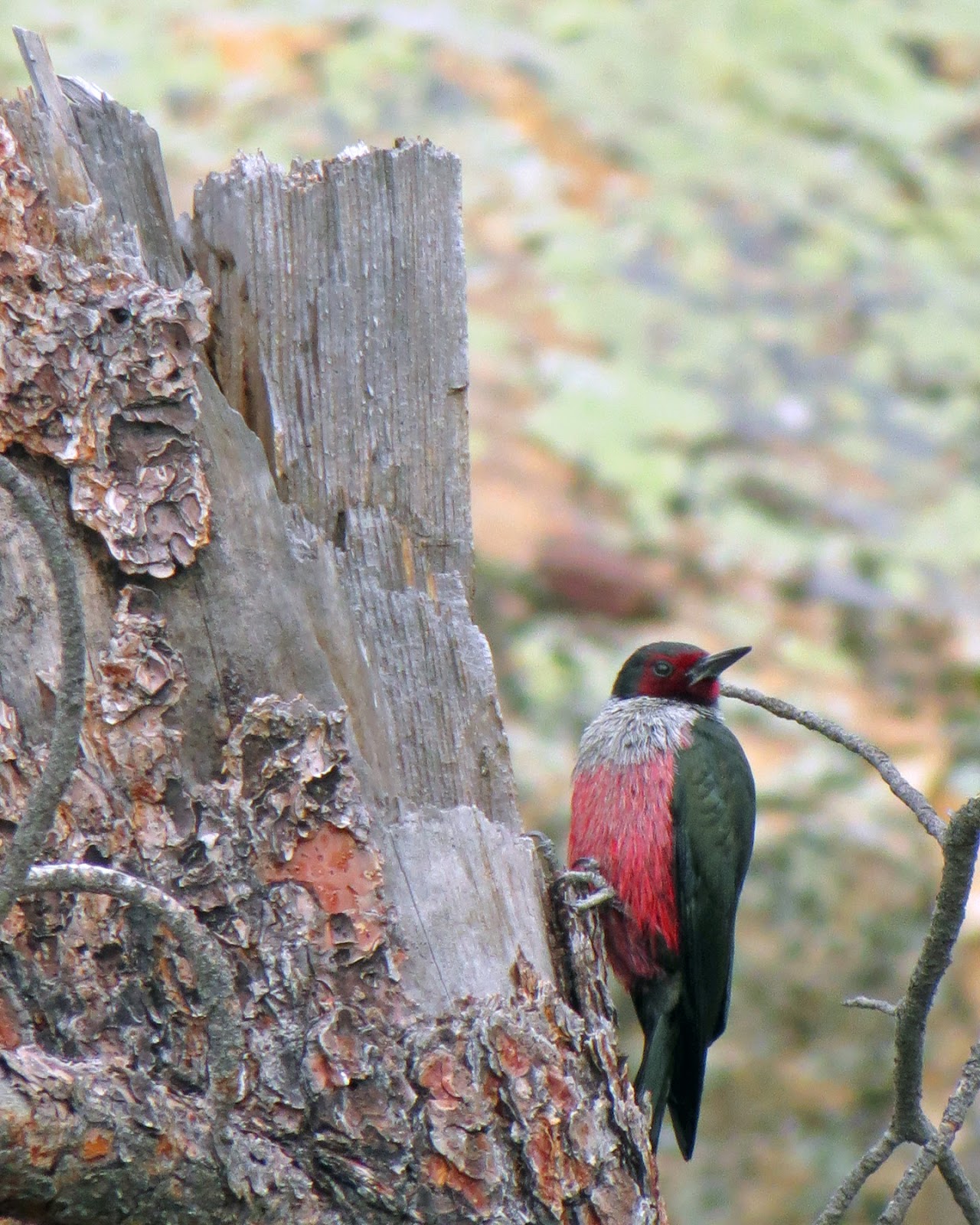
Lewis's woodpecker is one of my favourites in a family of birds I like very much. Thirty-five years ago it seemed easy enough to see all the Lewis's you could ever want. That no longer seems the case. We crossed paths with only two: one on the Planet Mine Road in the Nicola Valley, the other above the big rock bluffs at Vaseux Lake.

The greatest of long-distance travelers among New World songbirds is the lovely bobolink. Some of those that winter in South America make their way to southern BC to do their bit for the continuation of their kind. In 1986 Bruce and I had a good show of bobolinks in the fields along No. 22 Road near Oliver. This time, those same fields looking the worse for wear, Jan and I could find none.

Affecting the drawl of someone from the Oklahama Panhandle, Bruce and I liked to call this part of Canada the "drah" country, "drah" being analogous to what regular folk call dry. One of the driest places in all Canada is the sagebrush country surrounding White Lake, south of Penticton. Over the years I have been to White Lake several times. Annual rainfall is sparse there, just the way rattlesnakes and prickly-pear cactus like it. Some summers White Lake is a lake in name only: it evaporates entirely, leaving only a dry white alkaline flat to mark its passing.

But last week White Lake was as full as I'd ever seen it, and it was not too-hot sunshine that greeted our arrival, but rain. White Lake is an honest-to-goodness special place, an internationally recognized Important Bird Area that is one of the few sites in all Canada where a determined birder can hope to see the sage thrasher, an elusive songster whose habitat choice is given away by its name. On our recent visit there were no sage thrashers to be seen in the rain. We did note, however, a Nature Trust sign defaced by a fellow pilgrim opining that White Lake is--or should be--for cattle, not wildlife.

And so it went. It was perhaps more than a little foolish of me to expect that I would find the drah country as I first experienced it the 1980s. Driving through greater Kelowna to get from one birding destination to another took a full hour. Kelowna is far more city than it was the first time I laid eyes on it in 1976.

When I made my earthly debut way back in 1947 the world's human population was two billion and change--scary enough if you ask me--but now it is closing in on eight billion. How many of us will there be in another 72 years? How big will Kelowna be then? Who will prevail in the contest between those who say land is for livestock versus those who feel that important bird areas--just a few of them--should be preserved for birds rather than production of steak and hamburger?

Monday, October 8, 2018

The King is dead, long live the Queen


It was only a matter of time. In my August 30 post I regaled loyal readers with accounts and descriptions of the feverish fun generated in the 2018 Cape Breton summer season once table hockey took over as the cabin's prime entertainment mode. Faithful readers will recall that I crowed about the success I have enjoyed as a player lo these many years. But having played a few games with my unconscionably competitive cousins Lynn and Louise, I also predicted that my long-standing unbeaten record stood on thin ice.

Perhaps an update is in order. The cabin's 'sunroom', normally the scene of Bananagrams bloodbaths in which Lynn demolishes all challengers was transformed into a kind of hockey rink. The twins—Lynn and her 40-minute-younger doppelganger—decided that table hockey promised an arena-full of far better fun: Bananagrams was cast aside like last week's wilted lettuce.

I acquired my first table hockey game, oh, about a hundred thousand years ago. I managed to get neighbourhood friends to play but they never brought the sort of intensity I felt the game warranted and deserved. I was the only brother in a family of four and though two of my sisters are, like Lynn and Louise, identical twins, none of my sisters delivered the sort of frenzy that truly exhibits what a terrific game table hockey is. Starved at home for worthy competition, I decided it was just not in the nature of girls to want to destroy a table hockey foe. It turned out I was wrong, but it took decades for my error to be revealed.

Lynn and Louise are monozygotes of an entirely different stripe. They took to the game like a murder of crows to freshly cast-out bread crusts. We decided the way to make the most of table hockey was to organize an honest-to-goodness tournament, complete with a round-robin component followed by a playoff round culminating in a 'gold medal' game. So that's what happened. In each game the first player to three goals wins. Over the course of the last three weeks six tournaments unfolded. In most of the first five—some involving three players, some with four—I lost a single round-robin game before bearing down in the playoffs. I qualified for the gold-medal game in all five tournaments and—fortune favouring the bold—managed to bully my way to the gold medal in every one.

Perhaps it is not strange that in every single game I played those who stood and watched invariably cheered for my opponent. Any goal scored against me delivered unrestrained joy and euphoria not just on the part of the scorer but from everyone watching. I began to feel distinctly unloved.

Last Thursday evening, my third last of the 2018 Cape Breton season, delivered Tournament Number 6. This one was a four-way contest, pal Kevin Squires taking the fourth spot. That Kevin has table-hockey experience was immediately obvious in our round-robin game but because he had not played in years I was confident that I would prevail in our opening game. My confidence was entirely misplaced: Kevin won, 3-2. The round-robin results determined seeding for the playoffs. The second and third seeds—Kevin and Lynn­—squared off first. Lynn won. I exulted in a 3-0 shutout of Louise in the 1-4 matchup. Beware exultation. Fiercely competitive, the final game between Lynn and myself went on and on and on. Eventually the score stood 2-2. Then disaster. Lynn's right defenseman beat my goaltender cleanly on a vicious shot from behind her blue line. The game was over, the gold medal Lynn's. I managed not to cry.

Defeat was bad enough but what's worse is that redemption—or possible redemption—is a long way off. I have a wealth of time to lick my wounds: I will have to wait 'til next year to seek vengeance in another table-hockey slugfest. Until then Lynn can boast—and she most certainly will—that she is the defending gold-medal winner in the famed, ferociously antagonistic Bigadore table-hockey league.

What can I do? Perhaps it was the great Vince Lombardi who said, Show me a good loser and I'll show you a loser. Yes, I am a loser but I don't intend to be a good one. I have another table hockey game, in Victoria. I will dust it off and over the winter get ready to deliver vengeance in the summer of 2019.

Wednesday, September 26, 2018

Not to Mention Sandra Bullock Too


Any time I manage to organize a ramble with pal Peter Goodale I can expect that in addition to all the predictable rewards there will be payoffs of the offbeat, unpredictable variety. Such was the case on Tuesday. Motivated by the disclosure that Peter had never been there, I proposed we do the hike from storied Gabarus—a short gull flight across Gabarus Bay from historic Louisbourg—to the ghost village of Gull Cove, then on to Gabarus Cape and its commanding views over Cape Breton’s east coast and the open Atlantic. Take my word for it: Gull Cove and Gabarus Cape are worthy destinations, particularly on a day like the one we savoured yesterday--sunny, not-too-cool, entirely blithe. Best of all, we had it to ourselves; no other humans crossed our path.

One of the rewards of any outing with Peter—what should I call it, the sidebar attraction—is an almost guaranteed bonus. In Gabarus we took a short road to a construction site where Bud, the sibling of someone married into the Goodale clan, has been busily engaged in moving and underpinning a 150-year house with a fancy new foundation. Peter and I enjoyed excellent conversation with Bud and also had a tour of the old house interior. In the kitchen I tried but was unable to count all the layers of wallpaper that had their years in the sun over the past fifteen decades and are now exposed by Bud’s renovations.

For me the highlight of this particular sidebar was having Bud tell us that Sandra Bullock once sat here in conversation with the elderly matriarch who ruled the roost at the time. Now as it happens I am one among the millions of men who have taken quite the shine to Ms. Bullock and her movie appearances over the years. It seems that a few years back Miss Congeniality was in the midst of a film shoot in Cape Breton when someone told her about the charms of Gabarus. She went there and in the course of events found herself in the old lady’s kitchen. What must have been especially delightful for Ms. B was discovering that the senior citizen seated across the kitchen table had no idea who she was—didn’t recognize her, didn’t know her name, didn’t have the foggiest clue that she was in the presence of a beloved, world-famous actress. What a relief it must have been for someone who hardly ever gets to be anonymous.

We tore ourselves away from the scene of Sandra Bullock’s Gabarus kitchen moment to our trailhead. There, an old cemetery affords a final resting place for some of the folks who lived at Gull Cove a century and more ago. Nowadays no one at all lives at Gull Cove, no one, that is, of our own species. All that remains of the once thriving village are old house foundations. Whenever I see such a place I default to contemplating the transience of human affairs, the ephemerality of life. Such was the case yesterday.

Gull Cove is evocative but to put no fine point on it, the place is also beautiful, a landscape of open fields, sea cliffs and rocky headlands. Even without a binocular you can make out the buildings of the national historic site at Louisbourg. We crossed an expanse of cranberry barrens to Cape Gabarus, an excellent place to stop for a picnic of sardines, cheese and crackers. I felt septuagenarian gratitude that I am still able to walk that far under my own steam without having to rely on supplemental oxygen or require air ambulance evacuation.

While taking on replenishment at the Cape one can contemplate lovely little Green Island where a gull my gentle reader may never have heard of—the black-legged kittiwake—nests in greater numbers than anywhere else in the Maritime Provinces. If that is insufficiently alluring there is intriguing geology to contemplate and something else: the power of nature. Yesterday was quiet and calm but the beached lobster traps pitched inland far from shore and the occasional skeleton of a seabird wrecked by Atlantic storm demonstrate that some days at Cape Gabarus are anything but quiet and calm.

I can make no promise that an expedition to Gabarus and the trail to its eponymous cape will deliver the opportunity to hang out in a place redolent of Sandra Bullock but I can promise that the hike to Gull Cove and splendid Cape Gabarus is plenty enough reward all by itself.