Wednesday, June 8, 2011

Fogbound Among Bras d’Or Ghosts

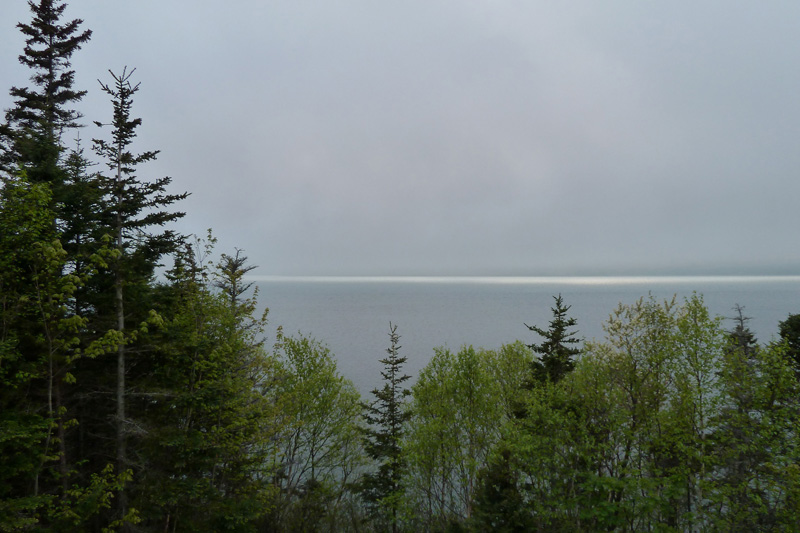
At Bigadore miserable weather perseveres. Every reveille produces the same vista: fog, drizzle, showers, cold, interminable grey. Many days the fog persists all day. The opposite shore of the Great Bras d’Or is but a mile away. Above it vaults Kelly’s Mountain. Frequently the whole day passes without a sight of the mountain. Hummingbirds shiver at the feeder, then topple over from hypothermia. If there is good news it is only this: judging by their absence the blackflies suffer too. The woodstove comforts, provides stored sunshine. Last fall I left the woodshed choked to the rafters with bounteous good fuel: maple, birch, apple. I begin to fear the stockpile will not last through June.

Latin scholars need not have me point out that Nova Scotia is Latin for New Scotland. The moniker suits. A few years ago Jan and I spent a month in Scotland on the bikes with best buds Mary and Mike. It rained every day but four. The following July, at Big Bras d’Or, the rains fell every day but two. So far June seems hell-bent on shattering the record, on making Old Scotland look good.

Lately I’ve been asked a good question: what is it that keeps me coming back to Big Bras d’Or. A very good question indeed. Blue skies and sunny days seem relics of the past. Feathered and furred wild things hide out from the weather. The binoculars are useless, the camera stays on the shelf. True, we are still far removed from the madding crowd. Of late there are no crowds whatsoever, madding or otherwise.

The more observant among our small gang of loyal readers may have noted in an earlier post that we celebrate Bigadore’s ruby jubilee this year. Forty years have passed since I first set saw to board, hammer to nail. In 1971 I was but 24. My best friend was 77. If Big Charlie were still living he would now be 117, almost the age attained by the incomparable Jeanne Calment. Kitty, my favourite aunt, hated my Shangri-la for precisely the same reason I loved it: at the end of my half mile of narrow winding woodland road it felt like the end of the world. Perfect, I thought. For Kitty it was Hell itself.
My neighbour Sarah Murray McPhail Patterson MacLean –- the world knew her as Sadie -– was a stalwart pal: good kitchen company and never any objection to the outrageous boob squeezes I perpetrated upon her person. Up on MacKenzie Hill Wally and Edith took pity on me once in a while, gave me a feed of cod and boiled potatoes. Now they are all gone. Every one.

Over the years Bigadore has availed an endless stream of projects. Never was I heard to say, ‘There is nothing to do.’ Over a string of fall weekends in 1974 I raced the 250 miles from Halifax in the wee smalls of Saturday morning, raced back on Sunday evening. With twelve hours of work each day I soon had my screened-in porch, still the best place on earth to achieve a good sleep. For a quarter century starting in ’75, whilst toiling in my Victoria saltmine, I had to make do with a month a year, always August. Emancipation in 1999 brought about a building boom: the sunroom in ’02, bathhouse in ’03, workshop in ’06. Along the way there interior improvements too: fridge, proper woodstove, skylights, cabinets, a bit of paint here and there. Not everyone appreciated the changes. But they would if it was four months they spent at the cabin rather than a few days.

Forty years will change a fellow’s perspective a tad. It isn’t novelty that brings me back, or a change in the cast of wild things that share the old place with us. No new buildings clamour that I pick up hammer and saw. Is it ghosts that draw me back? If ghosts are real -– many Cape Bretoners insist they are -– there must be a good number of them hanging about.

Back in 1971 I had a stretch in a Halifax hospital. A fellow patient, George Murray, taught me the rudiments of house framing. Ted Squires, himself a fine carpenter, supplemented the instruction. I left the hospital in April, came to Cape Breton, dismantled the derelict house then standing at Bigadore and, using hand tools only, framed the cabin in three weeks.

My great-uncle Harrison –- great in more ways than one –- insisted that it was the best thing I could possibly have done, that I saved my life by doing so. George, Ted, Harrison -- all of them now ghosts themselves.

Is it ghosts that bring me back, or merely habit? Perhaps I’ll wait to see whether the sun ever shows itself again before venturing an answer.
Saturday, June 4, 2011

Wild and Crazy

Up on MacKenzie Drive the foxes established at Wally’s old house continue to entertain. The bravest of the pups emerges from the basement den to look us over, wondering who the heck we are and what we’re up to. Last year a pair of two-legged squatters briefly occupied the vacant house before the RCMP showed up. I find the current squatters substantially more appealing, but wonder what Wally would make of it all. If he still walked among us the old guy would be 102. I like to imagine he’d be okay with his forsaken homestead being used for the raising of another young family before the old place finally melts back into Mother Earth. But the truth is, I doubt he’d be amused at all.

A pair of northern parulas -– one of the more attractive of our breeding wood warblers -– has set up housekeeping very near the camper, just up the hill from the cabin. The male seems to spend half the day singing his brains out, announcing to the world at large and especially to males of his own kind that he is king of the hill, cock of the walk, master of all he surveys. But all is not rosy in Parulaland. The handsome young fellow and his devoted mate are driven to distraction by a pair of rivals identically determined to establish themselves in the same territory. A sort of trench warfare is underway: the established pair keep launching attacks on the adversaries. The enemy gives as good as he gets -- exactly and precisely.

The rivals invariably appear in the same place: in the camper window opposite their nest. The window relates the history of the war in rich detail: bits of feather, various smears and stains. No matter how relentless the foes or futile their attacks, the parulas persevere. No light bulb turns on. No epiphany flashes. The warblers do not get -– nor will they ever -– that their enemy is their own reflection. It gets me wondering what sort of analogies apply to our own species: what sort of endless futility is pursued by H. sapiens that intellects of a higher order watch, scratch their heads about, perhaps even find laughably crazy.

Other birds entertain. Bigadore is a nursery not just for parulas but several other warblers -- black-and-white, magnolia, myrtle, Blackburnian, black-throated green, ovenbird –- not to mention the cast of thrushes, sparrows, finches and others. Their deeds to the place may be not registered at the county office in Baddeck but I recognize them as being at least as compelling as the one that is. Bigadore is a wildlife sanctuary without the formal designation. The first owl of the season -– a monosyllabic barred –- hollered from a nearby perch in the wee small hours a couple of nights ago. Squirrels rattle their challenges to one another. Snowshare hares -– their snowshoes still showing traces of winter white -– don’t say anything at all. They munch on the grass and imagine that standing stock still makes them invisible. Are they nervous when the nearby coyotes yip in the night? Footprints reveal the presence of bobcat in the neighbourhood, unseen to date. We shall keep our eyes peeled. There is one wildlife species I could do without: hordes of blackflies threaten to carry us off whenever we stand still. John Muir would argue that what is good for black flies is even better for warblers. I shall try to bear that in mind.

Wednesday, June 1, 2011

What Would Wally Say?

Up on MacKenzie Drive Wally-and-Edith’s old place, vacant for several years, now has new residents. This morning, as we emerged from the woods for the last kilometre or so of our pre-breakfast constitutional, we spotted an adult red fox at the corner of the old house, then two more faces -- pups hiding behind the rusting oil tank. We hid too, behind the spruce at the end of Bob Nagel’s driveway, to watch the show. A third young face made an appearance at the den entrance -- an opening in Wally’s basement wall. Then a fourth face, then -- just as we imagined that must be it -- a fifth. The youngsters played, competed for best position at feeding-station mom, conducted themselves in the nature of youngsters having not a care in the world. How charming that Wally-and-Edith’s is a home again. To a family of six, just as in the old days.

When we’re away on the opposite coast friend Gord Haggett, master gate-builder and rabbit stew fancier, harvests a few of the varying hares that flourish at Bigadore. I don’t mind at all: doubtless the stew his missus makes is a most worthy dish, and Gord’s depredations have no noticeable consequence -- the hare population appears to be as robust as ever. I wonder though whether our conduct around the rabbits gives the hunter an unfair advantage. Jan and I are harmless drudges: we ignore them and the bunnies soon grow complacent and fearless -- easy pickings for the merciless hunter. Perhaps it would even the odds a tad were I to impersonate Elmer Fudd, make threatening noises, shake a stick, holler ‘Say your pwayers, Wabbit!’

Strange sights on the Great Bras d’Or. Some loyal readers will know that northern gannets are a seagoing species. Until last year I don’t recall seeing one foraging the waters opposite the cabin. Last year we saw the occasional one or two. Lately the trickle has become a flood: six or seven dozen at a time on the water or diving headlong for fish. What gives? Why would gannets be moving to inland water? Do the birds know something mere humans don’t? Or is it simply that the 2011 smelt run is one for the ages?

On Sunday we hiked the North River Trail. Moose droppings littered the pathway much of the way. Folks who believe in ghosts might be drawn there. A century and a half ago these hills were a thriving community of Scots settlers – people named MacLean, MacKenzie, MacLeod and MacAskill. The old homesteads are gone now but their signs are left behind: old foundations, walls, cellar depressions.

Nowadays the forests along the way are dominated by hardwoods – beeches, sugar maples, yellow birch. It wasn’t always thus. A century ago North River provided a mother lode of softwood. As many as 900 men working with double-bitted axe and crosscut saw yielded a third of a million cords of spruce and fir over a thirteen year period. An old photograph shows a platoon of moustachioed young men sitting on a mountain of pulpwood. How many of them wound up in a different sort of platoon a decade later?

Ten days into the 2011 sojourn, things are greening up. Kelly’s Mountain, grey when we arrived, is verdant again. The Solomon’s-seal by the bathhouse, just four inches high May 20, is now two feet tall, the flowers about to bloom. But no, Jan will not plant her tomato and basil seedlings just yet. It was minus-one yesterday in the Margaree; frost is still a risk.
Late lamented Wally – who knew what he was talking about – insisted that Jan not do her planting till the new moon in June. She will heed Wally’s advice and bide her time by the warming Drolet while the threat of frost persists.